
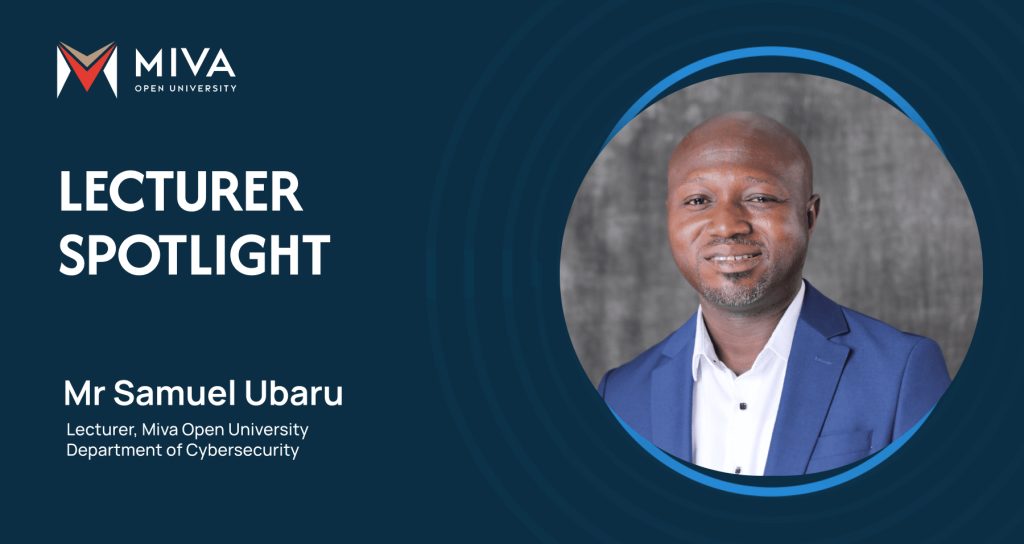
Behind every strong cybersecurity programme is someone quietly asking the difficult questions: Is this current? Is it practical? Will it stand up in the real world? At Miva Open University, Mr Samuel Ubaru is one of those people. As Programme Coordinator and Acting Head of Department for Cybersecurity, he operates at the intersection of academic rigour, industry relevance, and forward-looking research, ensuring that what students learn today prepares them for the realities of tomorrow.
With close to two decades of experience spanning academia and industry, Mr Ubaru brings depth and perspective to the classroom. He holds a Bachelor’s degree in Computer Science and Information Technology from Igbinedion University, Okada and a Master’s degree in Computer and Information Systems Security from the University of Salford in Manchester. Currently pursuing a doctorate in Cybersecurity at National Open University of Nigeria, he continues to expand his research in emerging digital threats and AI-driven cyber threat intelligence. Professionally, he has consulted for organisations and multinationals, while also earning globally recognised certifications through bodies such as EC-Council, alongside credentials in IT service management and project governance.
For Mr Ubaru, effective learning goes beyond theoretical explanations. It must translate into application. His lectures are grounded in real-world case studies, simulations, and practical scenarios drawn from professional experience. Students are not only introduced to cybersecurity principles but are challenged to analyse incidents, defend systems, and propose stronger solutions. In his view, learning is only complete when a student can independently apply knowledge to solve complex problems.
Relevance, he insists, is non-negotiable. In a discipline where threats evolve daily, outdated knowledge is not merely ineffective but dangerous. Teaching legacy systems without context does not prepare students for modern attack surfaces or cloud-based infrastructures. This commitment to currency aligns closely with Miva’s AI-forward environment, where lecturers are encouraged to adopt emerging technologies and integrate them meaningfully into curriculum development. For Mr Ubaru, this ecosystem fosters both innovation and accountability.
Teaching in a digital-first university has also reshaped his instructional approach. Unlike conventional classrooms, where spontaneous interaction shapes discussion, Miva’s blended structure requires anticipation. Lectures must address not only present questions but also those students may ask later. This model, he explains, demands clarity, foresight, and intentional design. Yet it also offers flexibility and inclusivity, enabling learners from diverse locations to access industry-aligned education without compromise.
Beyond technical competence, Mr Ubaru emphasises character. Cybersecurity professionals must operate with discipline, patience, and integrity. Beginners, he acknowledges, often feel overwhelmed by terminology and technical depth. His advice is consistent: progress in cybersecurity is cumulative. Mastery does not occur overnight, but steady effort transforms complexity into fluency. Patience, he believes, ultimately separates successful practitioners from those who abandon the journey prematurely.
His inspiration for teaching traces back to his father, a professor of Computer Science, who instilled in him the belief that true understanding is demonstrated through teaching. That philosophy continues to shape his approach. Success is measured not merely by academic results, but by former students who enter the field confidently and ethically. For him, legacy lies in producing graduates who secure systems responsibly and contribute positively to society.
What emerges clearly is that Mr Samuel Ubaru is not simply delivering lectures; he is constructing a foundation. Through industry-aligned curriculum, AI-integrated research, and a commitment to ethical practice, he is strengthening cybersecurity education at Miva Open University. If his students adopt his principles of patience, curiosity, and integrity, they will graduate not only as skilled professionals, but as responsible defenders in an increasingly complex digital world.
Leave a Reply