
Author: Esther Matthias

  • Discipline Will Take You Further Than Motivation — Or Will It?


    At some point in every semester, motivation stops working. The excitement fades, deadlines start stacking, and what once felt like a fresh academic journey slowly turns into routine pressure. In a system like Miva Open University, where learning is flexible but self-driven, that moment arrives faster than most students expect.

    Miva’s model is built on independence. Unlike traditional universities where attendance forces structure into your day, online learning shifts that responsibility back to the student. Lectures are available, assignments are posted, and deadlines are fixed — but how you move through all of it depends entirely on you. That is where the debate begins: is discipline really the ultimate factor, or do we underestimate how far motivation can actually carry a student when it is strong enough?

    Motivation usually shows up at the beginning of the semester. A new course feels exciting. You plan your study schedule, tell yourself you will stay ahead of deadlines, and maybe even promise to avoid last-minute stress. But after a few weeks, reality changes. Internet issues, personal distractions, other responsibilities, or even simple fatigue start affecting consistency. At that point, motivation starts to look unreliable.

    Discipline is what replaces it. In Miva, discipline is not abstract — it is practical. It is logging into the platform even when you do not feel like it. It is watching recorded lectures after a long day. It is submitting assignments on time even when there is no one physically reminding you. Unlike motivation, discipline does not depend on mood. It depends on routine.

    But here is where the contradiction appears.

    There are students in Miva who are not necessarily “disciplined” in a strict sense, but they are deeply motivated — and they still perform well. They stay curious, they engage more when they understand a topic, and they push harder when something interests them. Meanwhile, some highly disciplined students complete tasks consistently but without real engagement, and over time, they burn out or lose direction.

    This becomes clearer during assessment periods. Some students start strong but fall behind because they only study when they feel motivated. Others may not always feel ready or inspired, but they maintain a steady pace — one lecture, one assignment, one deadline at a time. Over time, that consistency builds better results than short bursts of effort.

    However, discipline is not always easy in a system like Miva. Online learning removes physical pressure, and that freedom can easily turn into delay. There is no lecturer physically calling you out in class. No peer pressure from sitting in a lecture hall. So if discipline is not intentional, learning can quietly slow down without immediate consequences.

    Still, motivation is not useless. It has its role. It gives you the initial push — the reason you start the course, register for classes, or set academic goals. But it rarely survives the full academic cycle on its own. It is too dependent on emotion and environment, both of which change quickly in student life.

    Discipline, on the other hand, survives those changes. It carries you through weeks when you are tired, distracted, or unmotivated. It is less exciting, but more reliable. And in a learning system like Miva, reliability matters more than intensity.

    The real challenge for students is not choosing between discipline and motivation, but understanding when each one is actually carrying them. Motivation starts the journey. Discipline keeps it stable. But sometimes — just sometimes — motivation is what gives discipline meaning in the first place.

    In the end, Miva Open University doesn’t just test what you know — it tests how consistently you can show up for yourself when no one is watching.


  • Welcome Back to Campus — A Fresh Start for the New Semester.


    Welcome back to campus, students. 🎓

    Although the semester resumed last two weeks, this is still an important moment to fully settle in, refocus, and realign your academic priorities. A new semester offers more than just a continuation of lectures — it is a structured opportunity to improve academically, rebuild momentum, and approach your studies with renewed seriousness.

    In the university environment, each semester is a critical phase in your academic progression. It is during these periods that courses are completed, credit units are earned, and cumulative performance is shaped. Whether the previous semester met your expectations or not, this new phase provides a clean slate to make intentional improvements in your academic work and study habits.

    Success at this level requires discipline and consistency. Attending lectures regularly, engaging critically with course material, completing assignments on time, and preparing adequately for tests and examinations are essential components of academic excellence. Unlike earlier stages of education, university performance is largely determined by independent effort and effective time management.

    Beyond grades, the university experience is also about intellectual development and personal growth. Each course is designed to build analytical thinking, communication skills, and subject-specific competence. How you engage with these opportunities will significantly influence both your academic outcomes and your readiness for life after graduation.

    As this semester continues, students are encouraged to remain focused, organized, and intentional. Avoid procrastination, take ownership of your learning, and seek academic support when necessary. Your performance is not defined by where you started, but by the consistency of your effort throughout the semester.

    # Note from the Editor.

  • Are Live Classes Still Necessary for Students in Today’s Digital Learning Era?

    This question is becoming increasingly relevant in modern education: do students still need live classes, or has digital learning already made them optional? With recorded lectures, AI tools, and self-paced study materials now widely available, the role of real-time teaching — especially in online universities — is being quietly rethought.

    Traditionally, live classes have been the backbone of structured education. They offered real-time access to lecturers, immediate clarification of concepts, and a sense of discipline that helped students stay consistent. Whether in physical classrooms or virtual setups, the live environment created a shared academic experience that kept learners engaged and accountable.

    In today’s online university systems, platforms like Google Meet have become the standard for live learning. For example, in institutions such as Miva Open University, lectures are delivered through scheduled Google Meet sessions, where students join remotely from different locations. The idea is to replicate the classroom experience digitally — with attendance, participation, and live teaching all happening through a video call instead of a physical space.

    But in practice, the experience is not always seamless. Many students face challenges such as unstable internet, power outages, device limitations, and conflicting schedules. Because of this, some learners rely heavily on recorded lectures or shared materials after the live sessions, which raises a practical question about how effective live attendance really is in fully online education systems.

    Still, live classes have a value that goes beyond just delivering content. They create academic presence. Students can ask questions in real time, participate in discussions, and receive immediate clarification. They also help maintain structure in a learning environment where it is easy to become disconnected or distracted.

    The real debate, however, is not whether live classes should exist, but how they should be designed. If they are simply repetitions of recorded material, their usefulness becomes limited. But if they are redesigned as interactive sessions focused on discussion, problem-solving, and mentorship, they remain an important part of the learning process in institutions like Miva and other online universities.

    So the real question is: in an era where students can learn anything at any time, what should live classes truly represent in online university education today?

  • Why This Cloud Security Workshop Might Be One of the Most Practical Sessions You’ll Attend This Semester.


    If you are a student in the School of Computing at Miva Open University, there is an upcoming workshop you should know about — especially if you are curious about cloud engineering, DevOps, or cybersecurity. The Innovation Hub is hosting a hands-on session titled “Building a Secure Cloud Environment: Cloud Security Essentials” on Friday, 6th March 2026, and it is designed to move beyond classroom theory into real-world application.

    Cloud computing powers most of the systems we use today, from mobile applications to enterprise platforms. However, many security breaches happen not because the cloud is unsafe, but because it is misconfigured. This workshop is structured to help students understand how cloud environments are properly secured and what practical steps professionals take to prevent common vulnerabilities. Instead of simply discussing concepts, participants will build and configure a cloud environment themselves using the Google Cloud Platform (GCP) Free Tier.

    During the session, students will be guided through creating a secure cloud foundation, setting up Identity and Access Management (IAM) with proper permission controls, configuring firewall rules, protecting stored data with encryption, and enabling logging and monitoring to detect suspicious activity. By the end of the workshop, participants will have implemented a mini secured cloud setup and gained a practical security checklist that can be reused in future projects.

    The session will be led by Babatunde Dawodu, MD/CEO of Pintop Technologies, who has experience in cloud DevOps engineering, secure infrastructure deployment, and production system monitoring. His practical industry exposure will help students understand how these skills translate directly into internships, freelance projects, and entry-level roles.

    This workshop is open to all computing students, particularly those exploring Cloud Engineering, DevOps, Cybersecurity, and Infrastructure Administration. Participants are advised to come with a laptop, stable internet connection, a Google account, and a basic understanding of networking concepts. Since this is a hands-on implementation session, early registration is encouraged as available slots may be limited. Students can register using the link below:

    https://forms.gle/RC25zJzffgfSCxoT7

    The goal of sharing this information is simple: to ensure that Miva computing students are not only learning technical theory but also building the practical skills that strengthen portfolios and improve career readiness. Workshops like this provide structured opportunities to practice what is taught — and that practical exposure can make a meaningful difference when preparing for internships and future technology roles.

  • Step Up Your Tech Career: MIVA Women in Tech Club Hosts Insightful Session.


    The MIVA Women in Tech Club is inviting all students and aspiring tech professionals to a not-to-be-missed session designed to boost careers in computing. On Thursday, March 5, 2026, at 3:00 PM, participants will gain practical strategies and actionable skills for thriving in the fast-evolving world of technology.

    Titled “Skills and Strategies for Building a Successful Career in Computing,” the session will feature Prof. Aderonke Oni, Professor of Information Systems at Covenant University, Ota, as the keynote speaker. Attendees will benefit from her wealth of experience, exploring essential skills, career planning tips, and guidance on navigating opportunities in tech.

    This session reflects the club’s mission to empower women in technology through mentorship, knowledge sharing, and professional development. It’s a unique chance to connect with an industry expert and gain insights that can shape your career path.

    Students and tech enthusiasts can join the session online via this link: tinyurl.com/Women-in-Tech-Club. Don’t miss this opportunity to take your next big step in tech and expand your professional horizon.

    Through initiatives like this, the MIVA Women in Tech Club continues to inspire, equip, and elevate the next generation of female leaders in technology, proving that with the right skills and guidance, there’s no limit to what you can achieve.

  • NNPC/SEPLAT JV Opens 2026 Undergraduate Scholarship Applications.


    The NNPC/SEPLAT Joint Venture has officially opened applications for its 2026 National Undergraduate Scholarship, offering a valuable opportunity for Nigerian students to secure financial support for their academic pursuits. This initiative underscores the commitment of both organizations to fostering academic excellence and empowering the next generation of leaders.

    Eligible students must be in 200 Level (Second Year) or above and possess at least five O’Level credit passes, including English and Mathematics, obtained in one sitting. Applicants are also required to maintain a minimum CGPA of 3.5, demonstrating consistent academic performance. These criteria are designed to ensure that the scholarship supports students with strong academic potential.

    Applications are submitted online via the official portal at:

    https://seplatgrowthacademy.com/scholarship/.

    Applicants must use a valid personal email address, and only those shortlisted will be contacted for further steps. Importantly, there is no fee to apply.

    The application window runs from February 23 to March 13, 2026, giving students several weeks to prepare and submit their documents. Interested and qualified students are strongly encouraged to apply early to avoid missing the deadline.

    The NNPC/SEPLAT JV scholarship program continues to provide essential support to deserving undergraduates, helping them to focus on their studies and achieve their academic goals without financial barriers.

  • Balancing Rest and Exam Pressures: A Smart Way to Prepare.


    Exams can feel overwhelming, and it’s tempting to skip sleep or push yourself to the limit. But your brain actually works best when it has the right balance of study and rest. Skipping sleep might feel productive, but it can make it harder to remember what you’ve studied and think clearly during exams.

    Here’s why: when you learn something new, your hippocampus (the part of your brain that stores memories) needs time to process and transfer that information to long-term memory. Without enough rest, your focus, problem-solving, and memory can take a hit. That means late-night cramming often does more harm than good.

    Taking short breaks while studying—like stretching, walking, or even a few minutes of deep breathing—helps your prefrontal cortex reset. This improves focus, creativity, and decision-making. Eating well, drinking water, and moving your body also support your brain, helping it absorb and recall information better.

    To stay sharp, aim for 7–9 hours of sleep each night, mix study sessions with short breaks, and use techniques like active recall and spaced repetition. You’ll find that a rested brain remembers more, thinks faster, and feels less stressed.

    Remember, exams are important, but so is your well-being. Treat your brain kindly, and it will reward you with clearer thinking and better results.

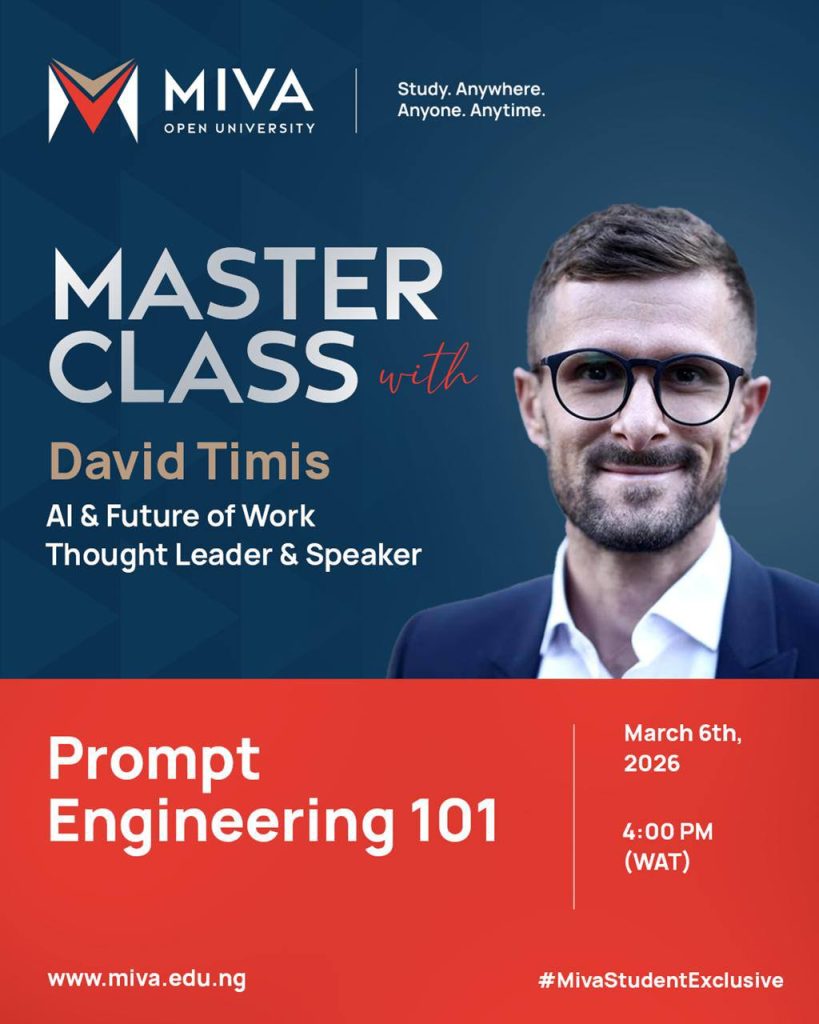
  • Miva Open University to Equip Students with AI Skills in Prompt Engineering Masterclass.


    As artificial intelligence continues to shape the modern workplace, Miva Open University is preparing students to stay ahead with a dedicated masterclass on prompt engineering. The session is designed to help students understand how to use AI tools more effectively by learning how to communicate with them clearly and strategically.

    The masterclass, titled Prompt Engineering 101, will be facilitated by David Timis, an AI and Future of Work thought leader. It will take place on Friday, 6 March 2026 at 4:00 PM (WAT) and is tailored to students who want to strengthen their digital skills regardless of their field of study.

    During the session, participants can expect to explore how well-written prompts influence the quality of AI-generated responses, why clarity and structure matter, and how prompt engineering can improve productivity across tasks such as research, writing, analysis, and problem-solving. The masterclass will simplify technical concepts and make them accessible to beginners.

    Students will also gain insight into how AI is transforming industries and why understanding prompt strategy is quickly becoming a valuable professional skill. By the end of the session, attendees should feel more confident experimenting with AI tools in academic, entrepreneurial, and career settings.

    Through initiatives like this, Miva Open University continues to position its students for relevance in a technology-driven future.

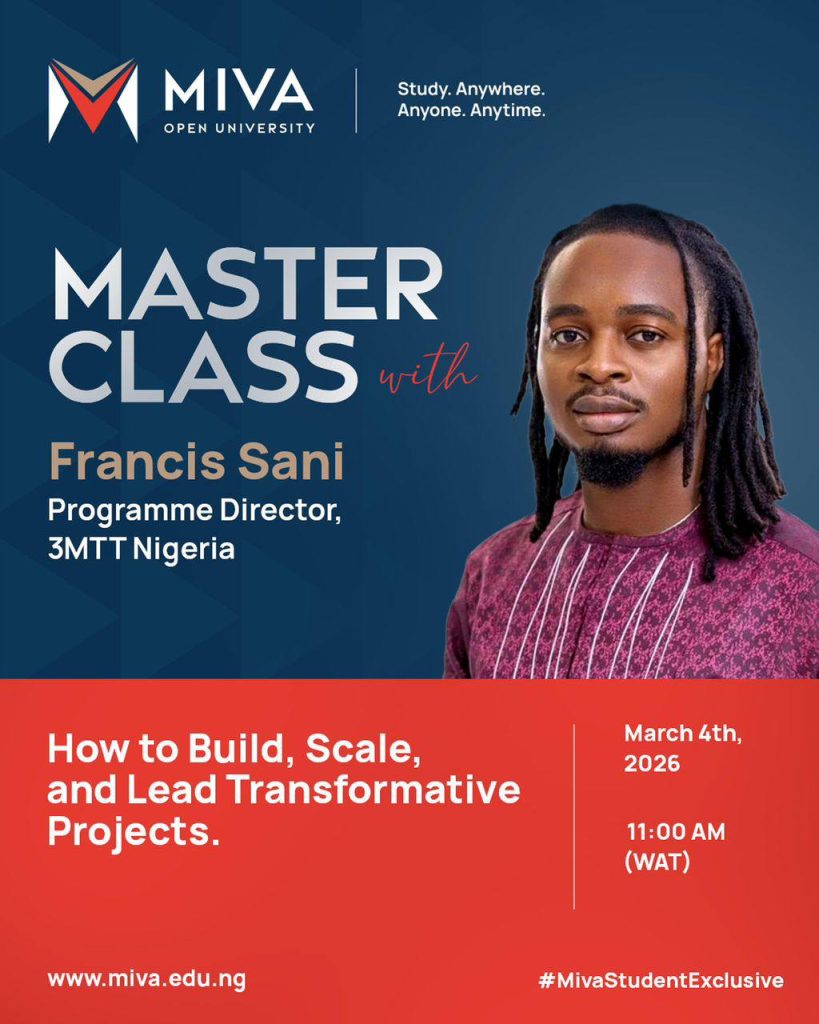
  • Miva Open University to Host Transformative Project Leadership Masterclass for Students.


    Students of Miva Open University are set to gain practical insight into what it truly takes to turn ideas into impact as the institution hosts an upcoming masterclass focused on building and leading transformative projects. Designed with aspiring founders, innovators, and career-driven students in mind, the session promises to bridge the gap between classroom knowledge and real-world execution.

    Titled How to Build, Scale, and Lead Transformative Projects, the masterclass will be delivered by Francis Sani, Programme Director at 3MTT Nigeria. Scheduled for Wednesday, 4 March 2026 at 11:00 AM (WAT), the session will draw from large-scale national project experience to show how structured thinking turns bold ideas into measurable results.

    Students attending can expect to learn how successful projects move from vision to execution, what strong leadership looks like in practice, and how strategy, teamwork, and accountability shape outcomes. Beyond theory, the session will provide relatable examples and practical insights that students can apply to academic projects, personal ventures, and future workplace roles.

    The masterclass also offers an opportunity for students to understand the mindset required to scale initiatives sustainably. Participants will gain clarity on common challenges in project delivery and how to navigate them confidently, especially in fast-evolving industries where adaptability is critical.

    With sessions like this, Miva Open University continues to ensure that its students are not only learning concepts, but preparing to lead meaningful change.

  • TalentPro Africa Partners with Miva for Exclusive Career Webinar Session.


    TalentPro Africa is set to host a dynamic and career-focused webinar in collaboration with Miva Open University this Saturday, February 28, from 2:00 PM to 3:30 PM GMT+1. The virtual session, which will hold via Google Meet, is designed to equip students and young professionals with practical insights to thrive in today’s competitive job market.

    The TalentPro X Miva Webinar comes at a time when many undergraduates and recent graduates are seeking clarity on how to position themselves strategically for internships, remote opportunities, and long-term career growth. With industries evolving rapidly and employers demanding more than just academic credentials, conversations like these have become increasingly important. This session promises to bridge the gap between classroom learning and workplace realities.

    Participants can expect an engaging and insightful discussion centered on employability, skill development, and navigating the African professional landscape with confidence. The collaboration reflects a shared commitment by both institutions to empower students not just academically, but professionally. By leveraging expert guidance and real-world perspectives, attendees will gain actionable knowledge they can immediately apply.

    Beyond the learning experience, the webinar also offers a valuable networking opportunity. Virtual events like this create spaces where students can interact with professionals, ask relevant questions, and begin building relationships that may shape their future careers. For many, this could be the spark that shifts their mindset from simply earning a degree to intentionally building a career.

    Interested participants are encouraged to secure their spot and join the session through the official event link:

    https://luma.com/join/gmzvEajwN7fnmmtW

    As the digital economy continues to expand across Africa, initiatives such as the TalentPro X Miva Webinar reinforce the importance of preparation, adaptability, and continuous growth for the next generation of professionals.